
26.10.2026
AIO versus custom loops: installation and maintenance
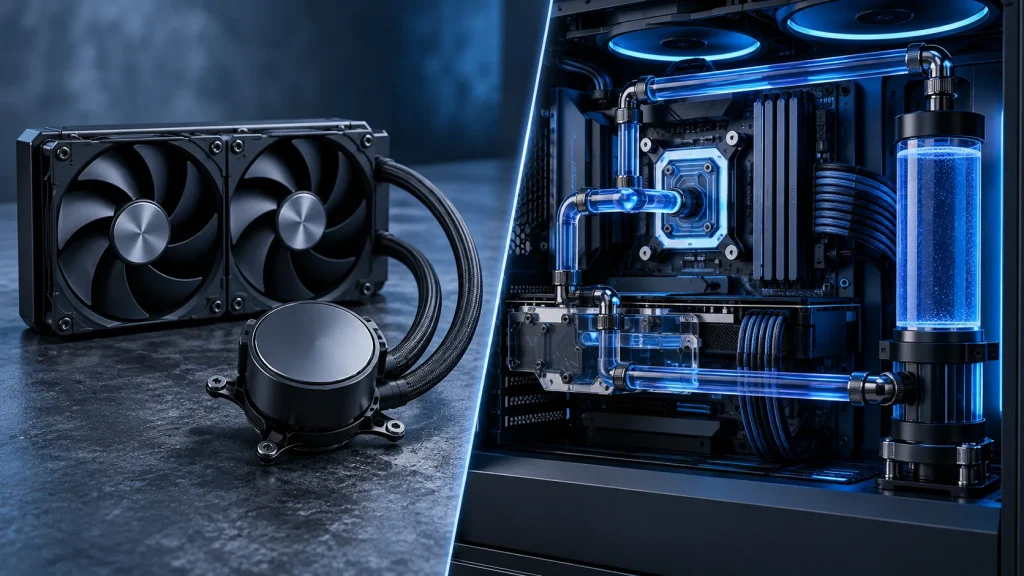
AIOs and custom loops both move heat using liquid, but they place different demands on the builder and owner. Consider the work after handover as carefully as the finished appearance.
Two system approaches
An AIO usually arrives as a connected cooling assembly. A custom loop combines separately selected blocks, a pump, radiators, tubing and fittings. It can be designed for multiple components, subject to compatibility across the complete loop.
Installation scope
AIO installation focuses on CPU mounting, radiator placement, tube routing and wiring. Custom work adds loop design, material selection, filling and draining arrangements, and leak checking. Inexperienced owners should arrange qualified technical support.
Agree the maintenance plan
Sealed AIOs generally do not require user refilling, but dust cleaning and operational checks remain relevant. Custom-loop servicing depends on the components and coolant. Follow their instructions instead of assuming one replacement interval fits every build.
Ask before commissioning
Who will service the system? Will you receive a component list and handover instructions? What changes when the GPU or case is replaced? Clarify support costs and warranty terms as part of the project.
Choose for ownership
Consider an AIO for a packaged assembly, or a custom loop for a tailored project with maintenance resources. A custom build is not automatically quieter or cooler than every AIO.
Technical references: darkFlash: AIO and custom-loop layouts.